{`What ₩100M and a company-wide reset taught us about AI transformation — part 1`}
We Paused Every Project for Two Months to Bet the Agency on AI Native Software Agency, Part 1
Lukas
Jun 4th 26
6 min Read
We Paused Every Project for Two Months to Bet the Agency on Agentic AI
In January 2026 we stopped taking on client work. Not slowed down — stopped. For two months, every person at Potential drew their salary to do one thing: learn to build with agentic AI. We walked away from two months of revenue and spent the better part of ₩100 million (~$70K) to do it.
This is part one of what that cost us, and what it taught us about AI transformation inside a real agency — not the LinkedIn-thread version, the actual one.
First, the context: a good year that made us a little arrogant
2025 was the best year we'd had. The pipeline never went dry, and we shipped:
- Four "best project" features on Behance (Adobe's global design community)
- Client work won from companies in Hong Kong, London, Dubai, Tokyo, and the US
We poured every won we earned back into the team. We grew fast — 20, 30, 40, 50 people — to the point where I could no longer tell you exactly what each person did day to day. I went from doing the work to managing managers, a job I'd never done before.
And I made every classic mistake of a 0-to-1 builder-founder who suddenly has to lead:
- "Why delegate a one-hour task when I can do it in ten minutes myself?"
- Spending my hours on low-leverage work
- Confusing the work I liked with the work I needed to do
- Still resenting money spent to buy back time (yes, even cab fare)
Running a Korea-plus-Bangladesh delivery team selling into Korea and abroad — probably the only agency in Korea structured that way — gave us higher operating margins than typical SI shops. Stable, profitable, growing. Which is exactly when you stop reading, stop asking better operators for advice, and get quietly overconfident. That was me from late 2025 into early 2026.
Then January 2026: I met Claude Code
The day I installed Claude Code on my laptop, I used it around the clock. I was genuinely afraid of what it would do to my industry — and genuinely thrilled by what it could do for us. We had a not-yet-100-day-old second daughter at the time, and I took the night feeds. Every three to four hours I was up anyway, so I'd check on what Claude Code had done, ship a little more, and go back to the bottle. Win for my wife's scorecard, win for my agentic-AI reps.
Then, at our first all-hands, I announced it:
Potential is stopping all projects in January and February. That means we are giving up two months of revenue. For two months you will be paid to learn a new craft — and you have to learn it. We are putting the entire team into agentic AI development methodology.
My reasoning to the team was blunt:
- A large share of software developers are going to disappear. And developers in emerging markets, with less access to frontier AI, are the most exposed.
- Don't learn this for the company. Learn it for yourself and your family. The only way not to be replaced by this technology is to use it better than the developer next to you.
- I'll go first. I'll learn it and share everything. Let's do this together.
That's how "We go all-in on Claude Code" started.
What going all-in actually looked like
We ran sessions every other day on the fundamentals. I built demo projects live, in front of the team, to show — not tell — what the next few years would look like. The energy was real; it felt like we were all facing the same direction.
The first surprise: I expected developers to take to it fastest. Instead our PM, Jayden, climbed quickest — probably the thrill of finally holding the steering wheel after years of waiting on developer confirmations and Slack replies.
The second surprise was harder. Going from directing managers to leading the charge myself, I could suddenly see every issue up close. My dev team could follow a known-answer path well enough — but when nobody had the answer yet, when the job was to design a workflow and share it across teams, they looked like amateurs. Even with a CTO in place, progress stalled. So I started designing every workflow myself. (I believe one day in 2026 is worth a month in 2036.) January was sleepless and relentless. Between Claude Code Max accounts, the projects we walked away from, and two months of payroll, we spent a lot — but it was money that had to be spent.
The result that stopped me cold
At the end of January I sat down one-on-one with everyone to gauge how well they'd absorbed it. These were people younger than me, without kids, in exactly the developer roles most exposed to AI — I assumed they'd be flying.
They couldn't grasp the most basic concepts of working with Claude Code. And it wasn't one or two people. The same gap showed up across the team, again and again.
So I ruled out the easy explanations:
- Not enough training? No — sessions every other day, with workflows pre-designed and handed to them.
- Not enough time? No — all client work was paused; there was literally nothing to do but practice.
- Not enough motivation? No — the news told them daily that AI was coming for developer jobs.
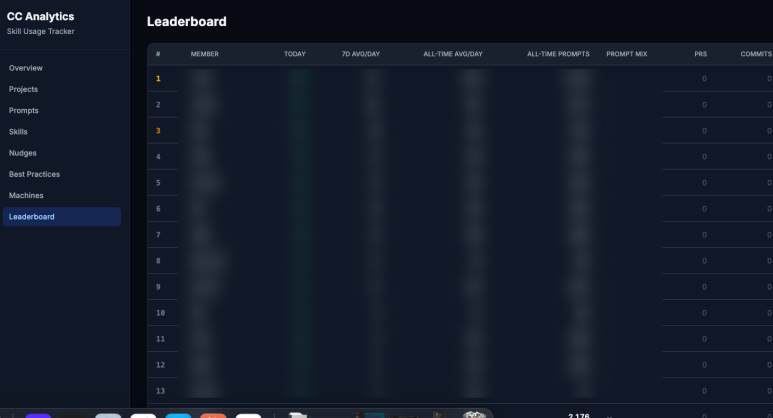
None of it explained the gap. So I made a drastic call: everyone, from me to the most junior hire, would make their AI usage fully transparent — prompts, token counts, all of it. That day we wrote the scripts and built a company-wide dashboard ("CC Analytics") and shared everything.
That's where part one ends — and where the real lesson begins. Continued in part two.
Potential (포텐셜) — the global-expansion development agency. The Korean agency that teams in Silicon Valley, London, Hong Kong, Dubai, and Tokyo call when they're going to market. → potentialai.com
Read next: [정말 잘하는 글로벌 CEO들] · [10개월만의 방글라데시 두번째 출장] (internal-link to the cluster posts on publish)


